Where Are You Standing?
Joseph Kosuth at Casa dei Tre Oci, Venice
1.
Friday, 1 May. The plan was simple: a late breakfast at Bar Zitelle, on the Giudecca, just a few steps from the Casa dei Tre Oci. A glass of white wine, a small plate, the Bacino with the Doge's Palace right across the water, the first warm morning of the season. But Zitelle was closed. Lavori di ristrutturazione, said the notice on the door — and it didn't take much imagination to connect this closure with the construction site one building over, where the new Airelles Palladio is preparing its arrival on the Giudecca: a hectare of garden, five restaurants, three bars including a bacaro of its own. A small, unpretentious neighbourhood bar doesn't usually survive the embrace of a new five-star hotel. Another piece of unforced Venice, probably gone.
Standing in front of the closed door, breakfast cancelled, I had a choice: turn around and take the boat back to the Zattere, or walk the few steps further to the Casa dei Tre Oci, where I had been meaning to see the new Kosuth show anyway. I chose the door that was open. The exhibition would keep asking me about that choice for the rest of the day.
The Tre Oci has worn several lives. The Bolognese painter Mario De Maria — Marius Pictor — built it for himself and his family in 1912–13. The name comes from the three large ogival windows on the main façade — òci, eyes in Venetian — which stand for the three surviving members of the family: Mario, his wife Emilia, his son Astolfo. The smaller mullioned window above is for Silvia, the daughter who had died young. A house built around a loss, with eyes that look out across the Bacino and one that looks elsewhere. After many decades, the Fondazione di Venezia restored it and reopened it in 2012 as a space for photography exhibitions, where over the years I discovered many wonderful photographers for myself. Since 2024 it belongs to Berggruen Arts & Culture. This time it hosts Joseph Kosuth's The-exchange-value-of-language-has-fallen-to-zero. The title alone is a programmatic provocation. I came for breakfast; I got Foucault on a wooden ceiling.
2. A chain of resemblance
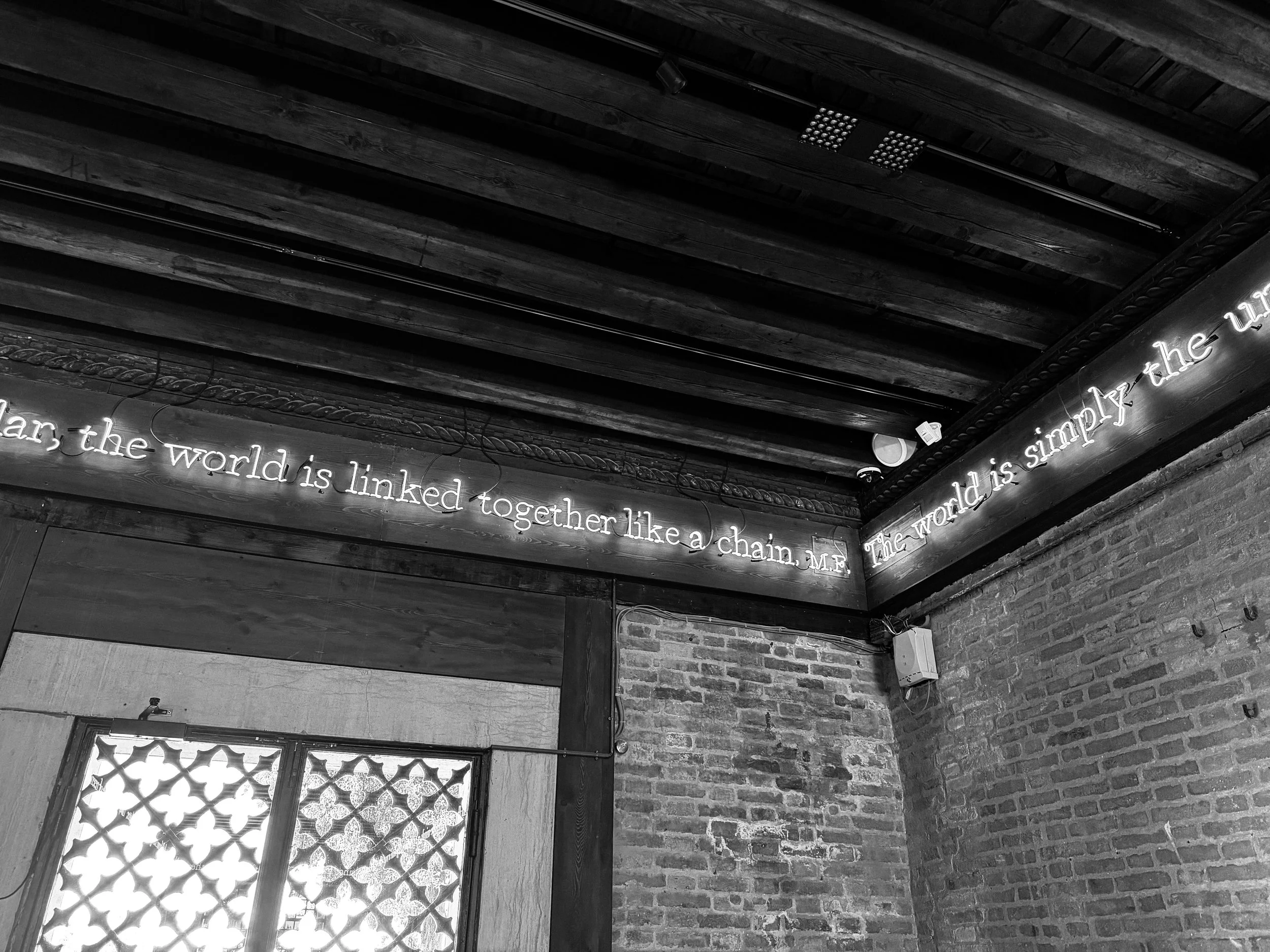
A Chain of Resemblance, 2026. Neon installation, Casa dei Tre Oci. Text: Michel Foucault, Les mots et les choses.
The new commission greets you above the entrance: a warm yellow neon line running along the early-twentieth-century beams, in cursive script rather than the cool capitals one expects of conceptual neon. The text is from Foucault — the opening pages of Les mots et les choses, where he describes the Renaissance episteme as a system of analogies and contiguities, water mirroring sky, things linked across domains in a continuous chain of resemblances.
The script follows the architecture instead of fighting it. And the work is already doing what it claims: meaning takes shape through context. The same sentence in a white cube would read as lecture; here, in a 1913 building that quotes Venetian Renaissance forms, in a city where San Marco's mosaics still order the world by similitude, the line about resemblances becomes part of the chain it describes.
3. The mirror and the clock
Inside, two of the Proto-Investigations from 1965 hang opposite each other: One and Three Mirrors and Clock (One and Five). Space and time, the two axes by which we orient ourselves. The mirror demands the viewer; without someone standing in it, the work is incomplete. The clock introduces a problem the chair version never had: the photographed clock shows a frozen moment, the actual clock keeps moving. Definition tries to catch what neither image nor object can hold.
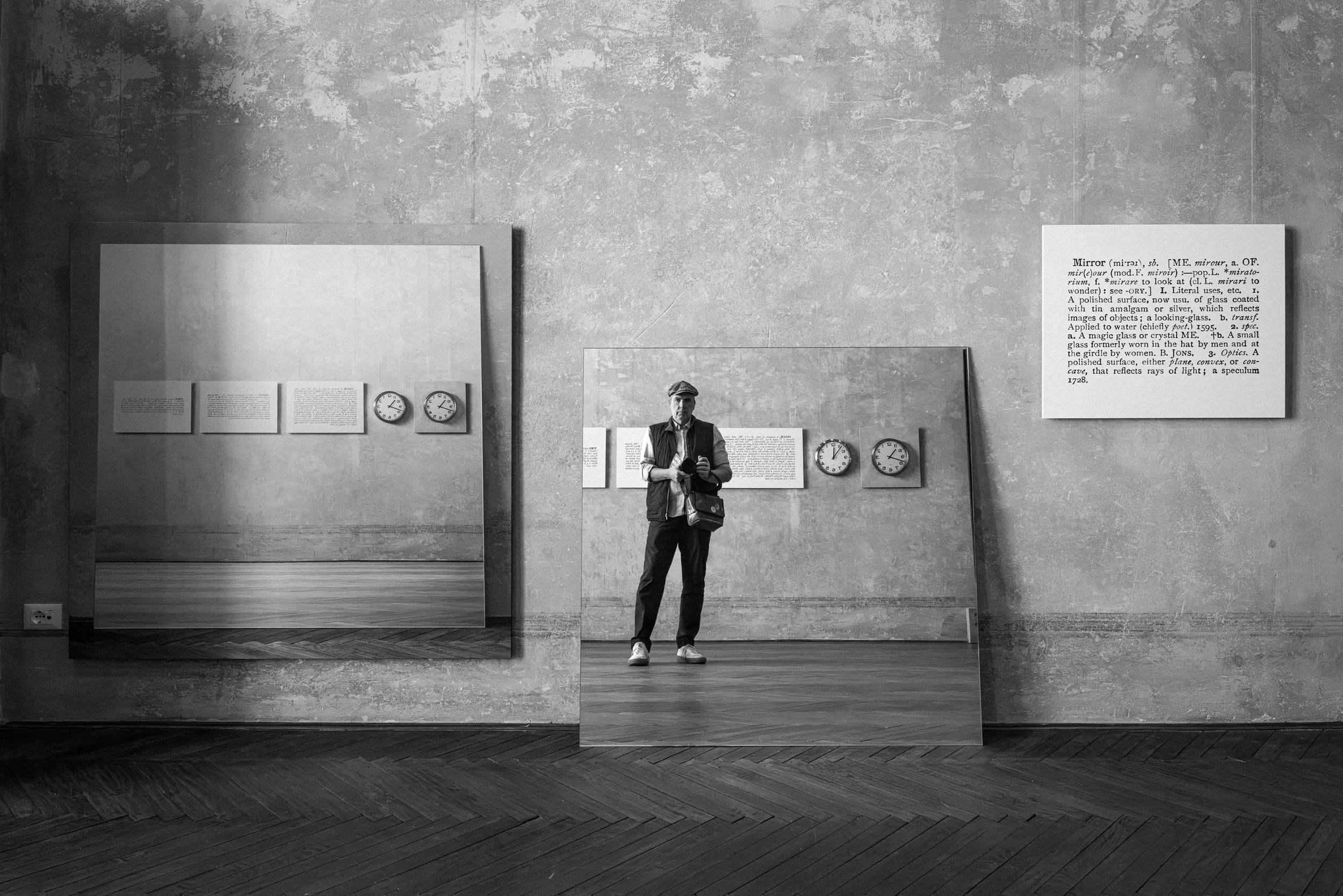
One and Three Mirrors, 1965. From the Proto-Investigations.
I photographed myself in the mirror, the camera held in front of my chest. Not a selfie pose — more a stance. Wittgenstein meant something close: meaning is use. The mirror functions only because someone stands in it.
Around all of it: peeling plaster, herringbone parquet, the patina of a building that ages while the clock runs. The conceptual frame floats on a slow material time it cannot fully account for.
4. Tautology against the wall
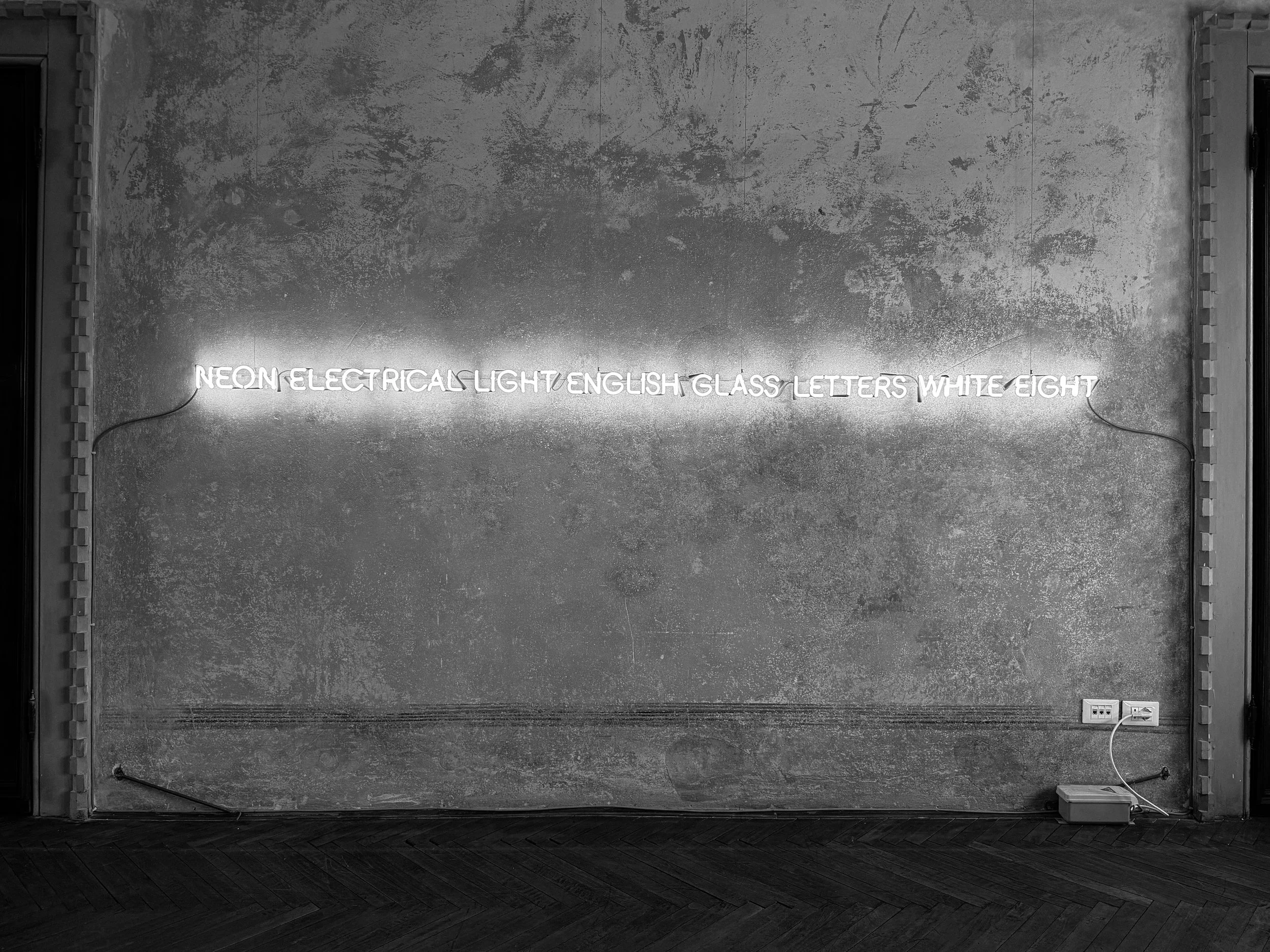
One and Eight — A Description, 1965.
A second 1965 work, in another room: a horizontal neon line that reads NEON ELECTRICAL LIGHT ENGLISH GLASS LETTERS WHITE EIGHT. One and Eight — A Description. Each word is true the moment it lights. The work describes itself completely and admits no outside.
But Venice doesn't allow self-sufficiency. The wall behind the neon — patina, watermarks, almost Twombly-like — tells a different story. The young Kosuth wanted a work that contained itself, that needed nothing beyond its own description. The wall answers: nothing here contains itself. The conduit running down to the floor, the little transformer on its plinth, the parquet, the doorframes left and right — all of it is the work too, even though Kosuth would have denied it in 1965. The tautology speaks; the wall answers. The piece is most itself in this productive contradiction, which is also a contradiction the artist has long since accepted, as the rest of the exhibition shows.
5. Take a copy
In a corner room, on a wooden pallet, a stack of A1 posters. Above them, a former wall niche — empty, blind, like a reliquary without contents. The poster is Where Are You Standing? / A che punto sei?, made by Kosuth with Sarah Charlesworth and Anthony McCall as the International Local collective for the 37th Venice Biennale in 1976. The work asks the visitor to choose a position: Producer, Intermediary, Consumer. Artist, dealer, public. Prendi una copia.
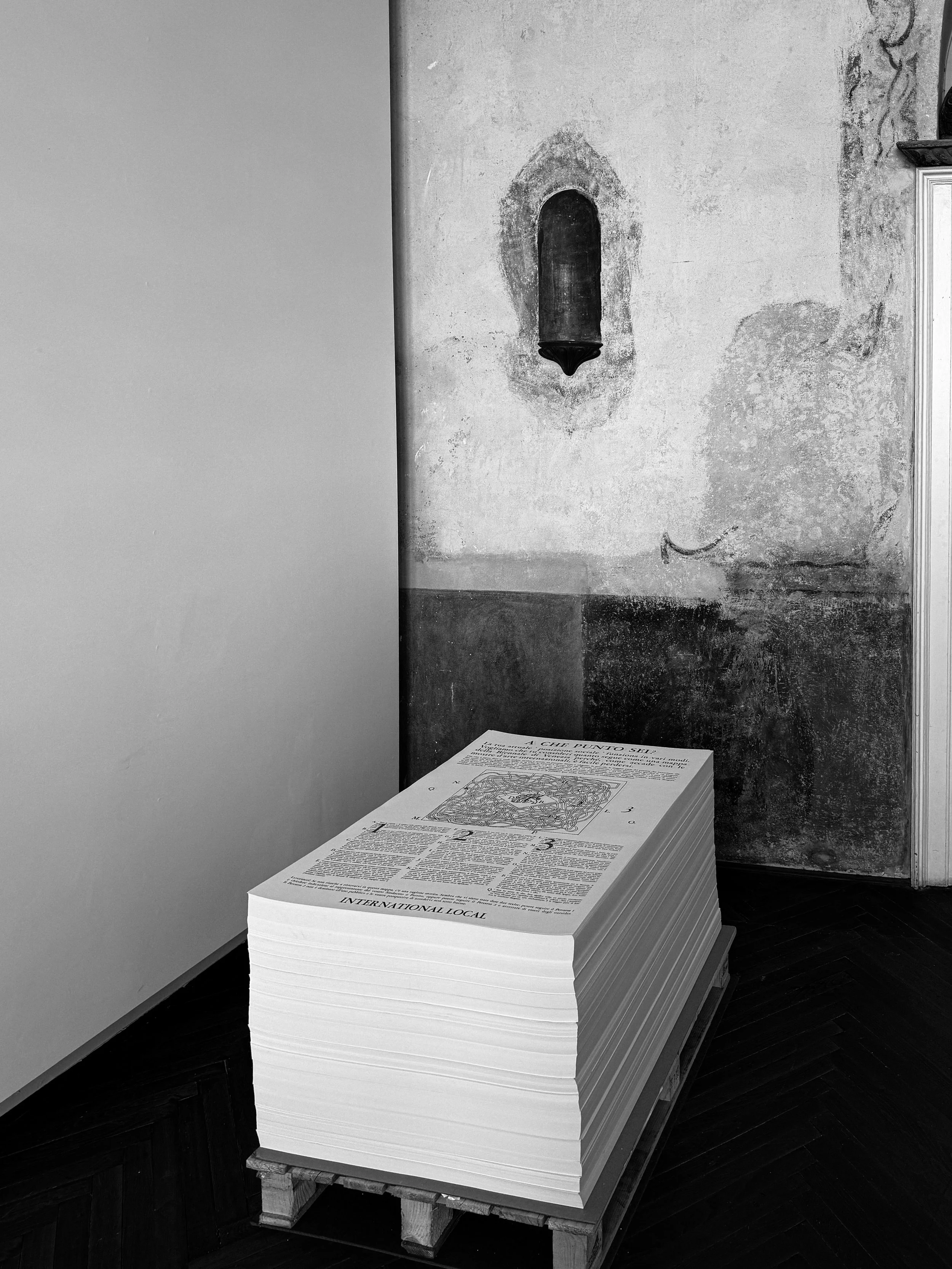
Sarah Charlesworth, Joseph Kosuth, Anthony McCall, A che punto sei? / Where Are You Standing?, 1976. Offset print, originally produced for the 37th Venice Biennale.
I know this question. Last summer I ran a leadership workshop in Kigali for the Ojemba team, and the title was a Venetian one: Come sta? In Venice, people don't ask "How are you?" but "How do you stand?" — a question about existential position rather than passing mood. The four sessions were variations of it: How do you stand in your story? In your team? With your challenges? Where do you stand — now?
So when Kosuth, Charlesworth and McCall offered the visitor of the 1976 Biennale a labyrinth and asked them to find their position in it, they were asking the same question I had asked a year earlier in Kigali, and that this city has been asking its inhabitants for centuries. Come sta? The poster on the wooden pallet today is a fifty-year-old echo, but the question is older than that.
I take a copy. Of course I do — any other choice would be a betrayal of the work. Today I am Producer, Intermediary, Consumer at once: photographer, blogger, exhibition visitor. The poster knows this and doesn't simplify.
6. Text and context
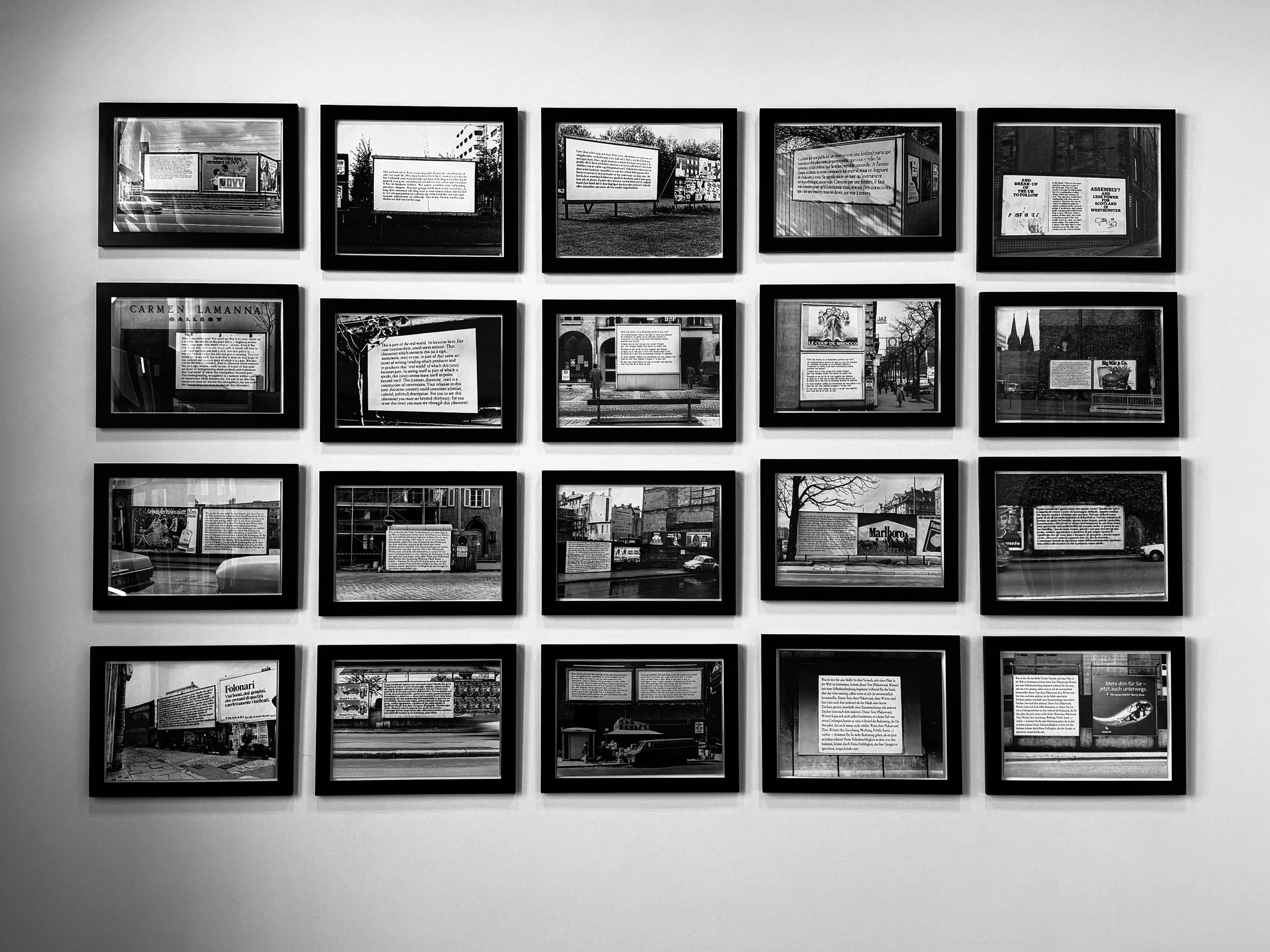
Text/Context, 1978–79. Twenty framed photographs documenting billboard installations in cities across Europe and North America.
Twenty black-and-white photographs from 1978–79, hung in a grid in a brighter, more neutral room: billboards across Europe and North America, where Kosuth has placed paragraphs of his own text in place of advertising slogans. Cologne, Eindhoven, Paris, New York, Toronto, Munich. Marlboro next to Kosuth. Le coup de Sirocco next to Kosuth. Big Mac next to Kosuth. Each photograph documents an act of translation: the same words, different street, different language, different reading.
The German text on one of the panels says, more or less: What kind of place is this? In trying to assign itself a position in the world, this text could begin with a self-description, while you are reading it; but that would be unnecessary. These words are placed here as the content of an empty sign, within a context of other signs. If this billboard lost its assignment — advertising, politics, art — could you give it more meaning than it now seems to have? Your capacity to participate in what this means may be limited by your inability to ignore what is being said.
That last sentence is the catch. Reading is not free. Once the words are in your visual field, you cannot un-read them. And precisely this physiological compulsion — to read whatever is in front of you — narrows the freedom you have to interpret.
But this cuts against the exhibition's other argument. If meaning takes shape through context, as Foucault's neon insists from the ceiling, then context should open meaning, not close it. There seem to be two Kosuths in this exhibition: the one who frees meaning into context, and the one who admits that context binds the reader. The show doesn't reconcile them. Perhaps it shouldn't.
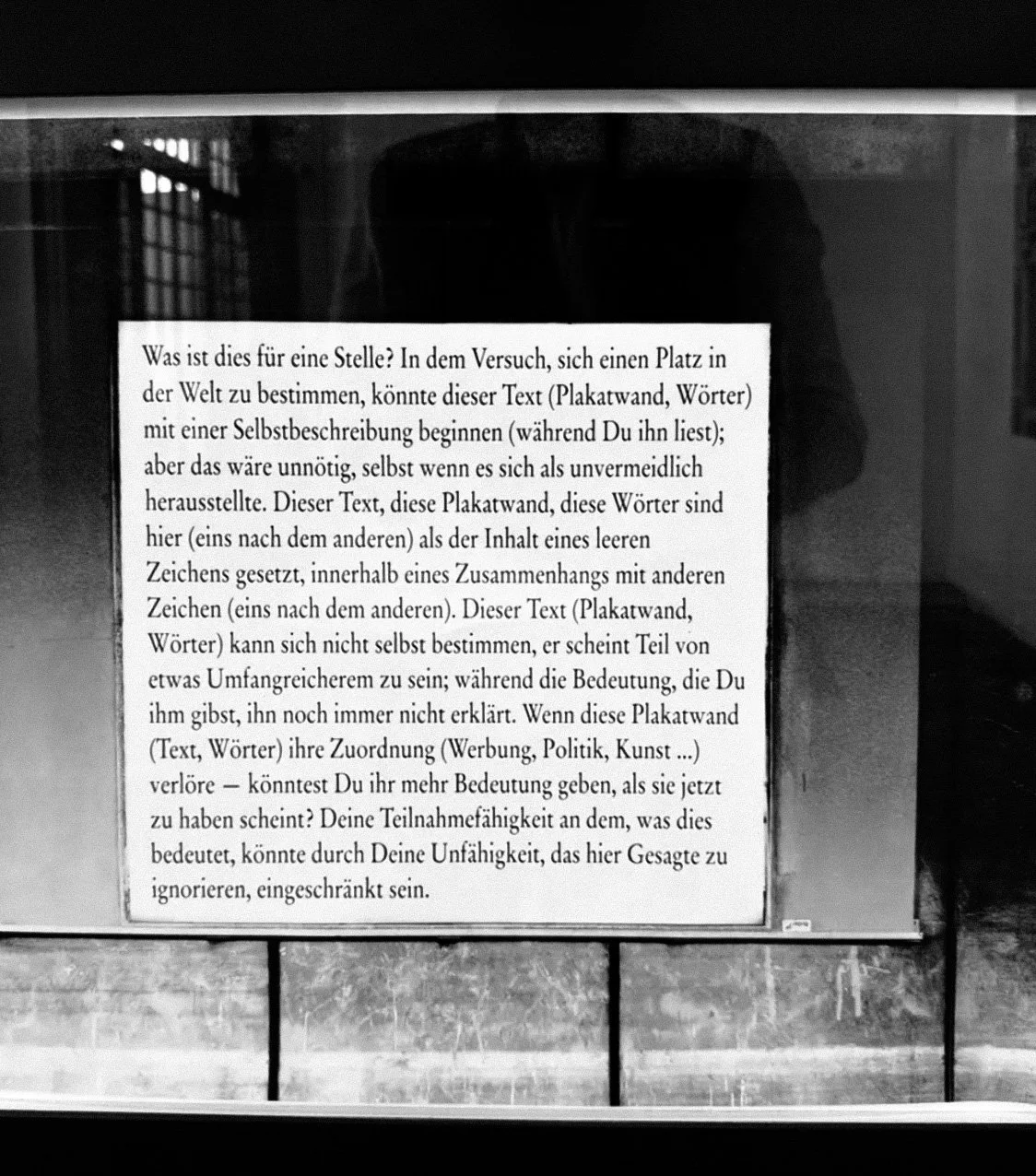
Text/Context, 1978–79 (detail). Original German text from a billboard installation, photographed in the exhibition glass.
When I leaned in to photograph the panel, I found myself in the glass: cap, shoulder, the faint outline of the camera, superimposed over the text. During you read it. The reflection isn't a flaw; it's a small piece of evidence for the very compulsion the text describes — I could not not read.
This, I realised, is also what I do with my own camera. Photographing shop signs, wall texts, advertising, posters in cities. Text/Context without the framing of a name. Kosuth makes visible what street photography has been practicing all along.
7. Lunch on the other side
By the time I left the Tre Oci, the rolled A1 was tucked under my arm and the missed breakfast had grown into something like an appetite. Bar Zitelle was still closed, of course; the boat back to the Zattere was the only option. Vongole veraci at Riviera, a glass of Franciacorta, the Molino Stucky in the distance, the long line of the Giudecca laid out across the water. Somewhere in that line of buildings: the Tre Oci, with Kosuth's neon glowing above the entrance, a small yellow line on a long island. Two doors down, the closed bar. Two doors further, the rising hotel.
The poster came home with me to Campo Santa Margherita and leaned against the wall of the apartment for the rest of the afternoon, asking its question to the room.
8. The banner across the canal
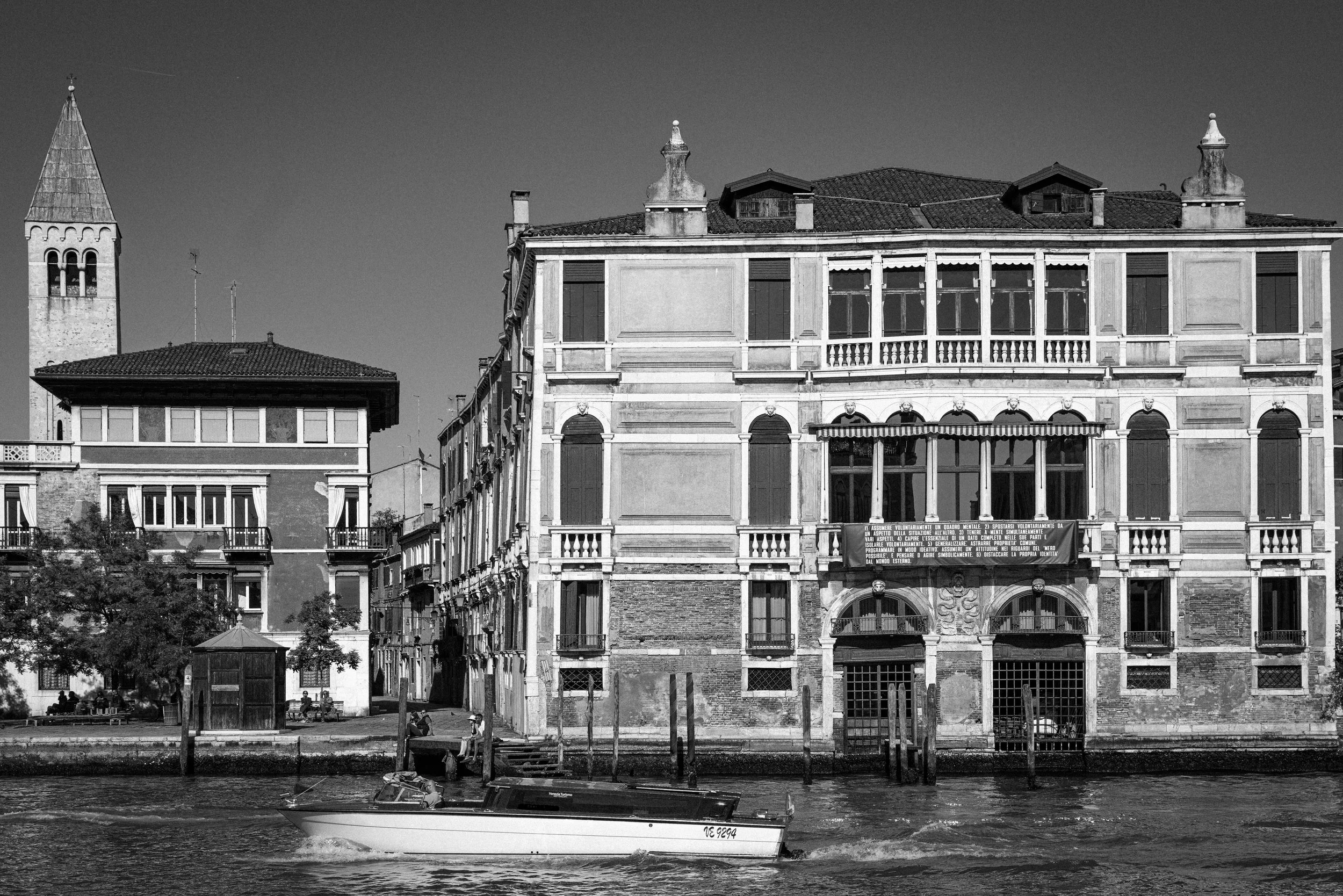
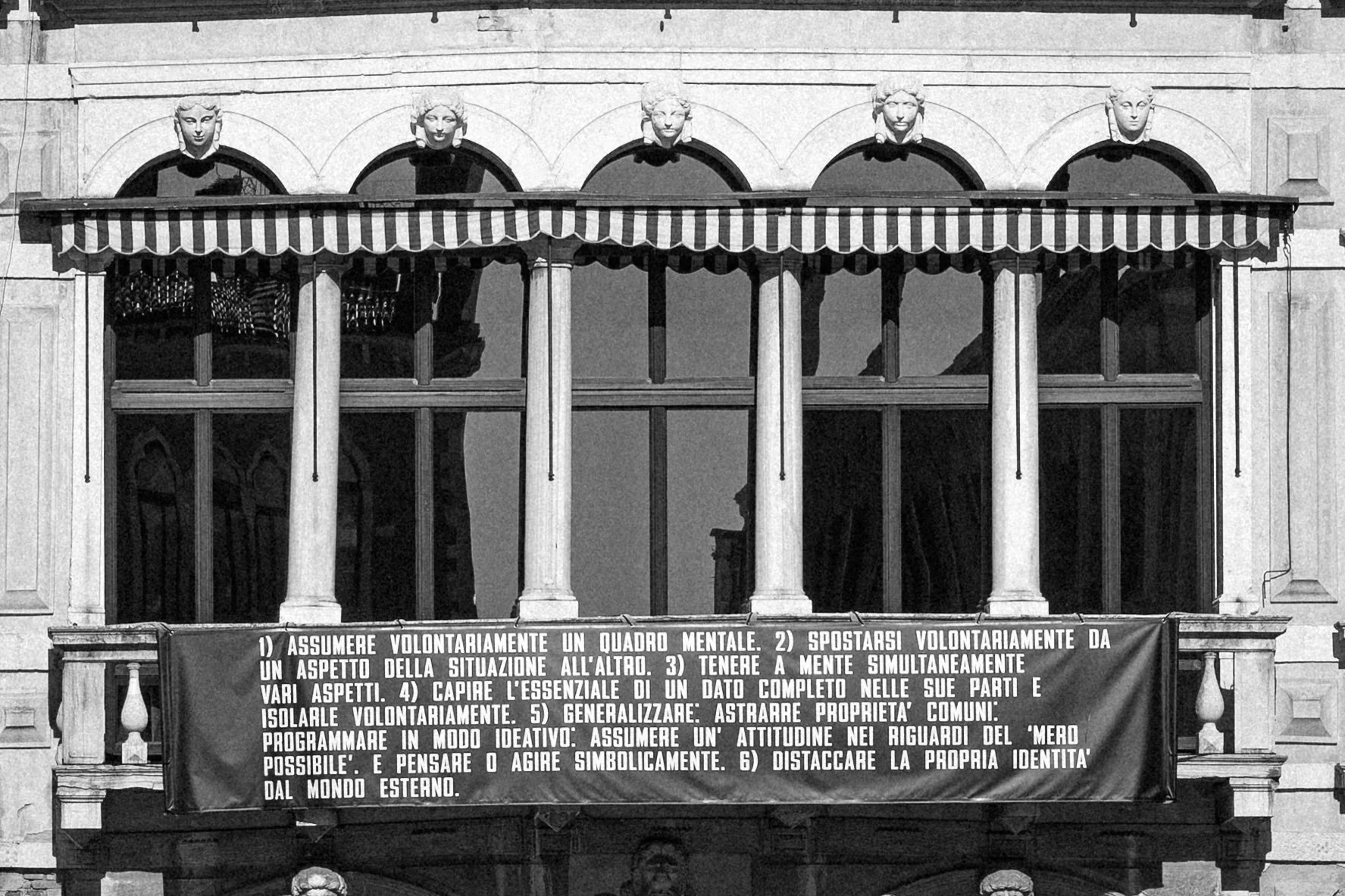
The Seventh Investigation (A.A.I.A.I.) Proposition One, 1970, on the façade of Palazzo Malipiero. Text: Kurt Goldstein and Martin Scheerer, Abstract and Concrete Behavior (1941).
In the late afternoon, I walked back out — across Campo San Barnaba, down toward the Grand Canal, to the vaporetto stop Ca' Rezzonico. Because the exhibition's most radical gesture isn't inside the Tre Oci at all. It hangs across the city, on the façade of Palazzo Malipiero on the Grand Canal. The Seventh Investigation, originally from 1970, re-installed for this show.
The text is six points from Kurt Goldstein and Martin Scheerer's 1941 work on the abstract attitude — the cognitive operations that distinguish thinking from mere reaction. Voluntarily assume a mental frame. Voluntarily shift from one aspect of a situation to another. Hold multiple aspects in mind simultaneously. Grasp the essential of a complete given and isolate its parts. Generalize, abstract common properties, plan ideatively, take an attitude toward the merely possible, think or act symbolically. Detach the self from the outer world.
Hung above the Grand Canal, on a Renaissance façade with five mascaroni leaning out from the lunettes above the text, the banner asks the impossible. Passing boats have three seconds to read; the city's noise prevents abstraction; detachment is precisely what Venice doesn't allow. Goldstein originally described these operations by observing brain-injured patients who had lost them. Kosuth's gesture suggests we are all those patients, the moment we step into the street — not because we are damaged, but because the conditions for the abstract attitude are conditions a city makes hard to keep.
A small boat passed through the frame as I released the shutter. Three seconds. The chain of resemblance closed: water, stone, language, reader, reading. Foucault on the ceiling at Tre Oci, Goldstein on the Malipiero. The same proposition, twice.
I kept noticing, on the way home, where things stood. What framed them. What the light did to letters on a banner. The exhibition kept working, even after I had left it.
Where am I standing? On a fondamenta on the first of May, in a city negotiating which doors will stay open and which will close, with a rolled A1 at home leaning against the wall — asking the question.
Joseph Kosuth: The-exchange-value-of-language-has-fallen-to-zero.
Casa dei Tre Oci, Giudecca, Venice. Curated by Mario Codognato and Adriana Rispoli for Berggruen Arts & Culture and Berggruen Institute Europe. Until 22 November 2026.