A note on stumbling over the right word in an Italian crime novel.

Puglia. Where the word surfaced.
I came across the word in a crime novel. Gianrico Carofiglio, the Italian writer who used to be an anti-mafia prosecutor, was describing a character called Lorenza:
"Years later I came across the perfect expression for this attitude — an attitude that finds it hard to make room for other points of view. The word, coined by David Foster Wallace, is ambiguphobia. Lorenza was a textbook ambiguphobe."
I put the book down.
Not because the word was new — ambiguitas and phobos are both ancient — but because at that moment a set of half-formed observations suddenly had a name. People I had worked with. Meetings I had sat through. Conversations that had gone sideways for reasons I could never quite locate. Not intolerance in the moral sense. Not fear of logical contradiction. Something more specific and more intimate: the inability to bear that a situation might admit more than one valid reading at the same time.
The word did not give me a new thought. It gave a name to thoughts I had been circling for years.
A novelist who reads philosophy at night
That the word surfaces in one of Carofiglio's novels is not an accident. Carofiglio is worth reading for a number of reasons. His Guido Guerrieri novels — legal thrillers set in Bari, where Guerrieri works as a defense lawyer — have an unusual quiet to them. They are crime novels, but the real drama is inside the courtroom and inside the narrator's head. The book in which the passage above appears is La misura del tempo (2019, German Zeit der Schuld, English The Measure of Time, tr. Howard Curtis, Bitter Lemon Press 2021). Italian critics have called it a conte philosophique wearing the clothes of a thriller, and they are right. It circles around the plurality of possible stories, the unreliability of memory, the difficulty of telling one truth from another and of holding them both at once.
Alongside the fiction, Carofiglio has written a short, precise essay called La manomissione delle parole — “The Tampering with Words” — on how political language gets broken, and how we might repair it. For him, the capacity to bear ambiguity is not a literary flourish. It is a civic competence. Courts are his laboratory for the question: when does clarity serve justice, and when does it prevent it? A lawyer who cannot hold two possible readings of the same evidence at the same time is not a rigorous lawyer. He is a dangerous one.
It is no wonder, then, that he seeds his novels with philosophical terms. The word ambiguphobia does not arrive in his fiction as ornament. It arrives as diagnosis.
The easy answers that don't hold
You might think the obvious antonym is tolerance. But tolerance is too tired a word, and it has the wrong architecture. It describes what I am willing to put up with. It keeps the tolerator at the center and asks how much he can stand before he reacts. The other person remains a guest on sufferance.
Ambiguity tolerance, the construct Else Frenkel-Brunswik introduced in the 1940s while measuring authoritarian personality structures, is historically important but stays on the level of individual cognitive stamina. It tells us nothing about what happens between people when one of them makes room for another's world.
Keats came closer, I think, in a letter to his brothers just before Christmas 1817. He called it negative capability: the capacity to remain in uncertainties, mysteries, doubts, without any irritable reaching after fact and reason. That is beautiful, and it is more than tolerance. But it is aesthetic, contemplative, solitary. The poet alone with the ambiguous world.
What I wanted was something relational. Something that names not just a state of mind but a way of being with another person. Something that understood that making room for another point of view is not a private virtue but a social act — an act that costs something, that can fail, and that carries an ethical weight.
I found two words. One comes from Emmanuel Levinas, the other from Mikhail Bakhtin.
Hospitality, from the outside in
Levinas was a philosopher of the Other — a Lithuanian Jew who had lost most of his family to the Nazis, who spent the war in a German prison camp, and who afterwards wrote philosophy as if ethics came before everything else. Before epistemology. Before ontology. Before the self.
His central claim sounds strange the first time you hear it: the self is not originally alone. There is no isolated “I” that later, generously, decides to let others in. The other person is already there, already making a claim on me, before I have even organized myself into a coherent subject. Le moi, c'est l'hôte, he writes — “I” am the host, but the word also means guest. The self is always already hosting, and always already a visitor.
From that grammar he draws a concept: hospitality. Not in the suburban-dinner-party sense. In the sense of a fundamental disposition — the disposition that makes room for the other person without first demanding that she prove herself identical to me, useful to me, or amenable to my categories.
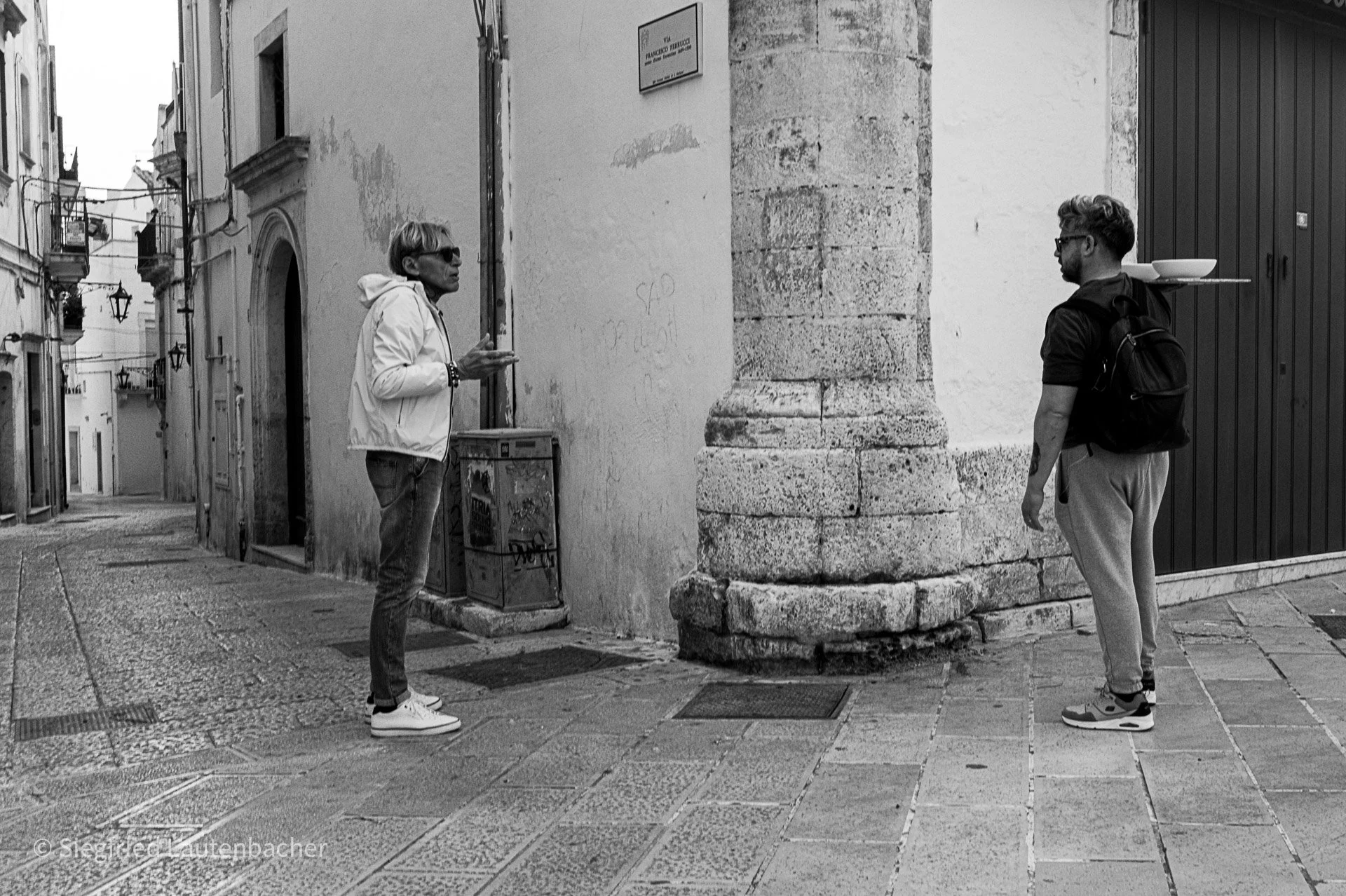
One speaks, one listens. Between them, stone.
Jacques Derrida, Levinas's great reader, later pushed this into a paradox. Unconditional hospitality is the only hospitality that really is hospitality — the guest is welcomed before I know who she is, before she has met my conditions. Otherwise it is just a contract. But unconditional hospitality is also impossible, because it would destroy the host: if I turn no one away, eventually I have no home left in which to welcome anyone. Every real act of hospitality lives inside that impossible tension.
What I want to call perspectival hospitality is the application of this to how we hold other people's points of view. It is the capacity to let another's way of seeing the world take up residence in me — not as a threat to my own vision, not as a temporary irritant to be processed and dismissed, but as something that might actually change the room I live in.
It is the outward face of not being ambiguphobic.
Polyphony, from the inside out
But that is only half the story. Hospitality describes what I do toward others. It says nothing about the condition of the self who is doing the hosting.
Here Bakhtin helps. In his book on Dostoevsky — written under difficult conditions in Stalin's Russia — Bakhtin argues something that seems obvious once stated: Dostoevsky's novels are not monologues. The narrator does not sit above his characters understanding them better than they understand themselves. The characters have their own voices, and Dostoevsky as author does not absorb them into a single authorial perspective. He lets them speak, even when they disagree with him, even when they are wrong.
Bakhtin called this polyphony.
The radical claim beneath this is philosophical, not just literary. Truth, Bakhtin suggests, might not be a single thing held by a single consciousness. Truth might be something that only exists between irreducible voices, in the space where they meet and do not collapse into one another.
Polyphony is the inner counterpart to hospitality. It describes the self as already plural — not fractured, not confused, but constitutionally capable of carrying more than one voice at the same time. The polyphonic self does not have to resolve its internal disagreements before it can meet another person. It brings its own multiplicity with it.
Together, the two words cover the ground. Hospitality is the relational posture outward. Polyphony is the inner constitution that makes the posture possible.
This, I think, is what Adler was pointing toward when he insisted on Gemeinschaftsgefühl — social feeling, community feeling, though no English translation quite holds it. It is more than benevolence. It is an orientation of the self that shows up as specific capacities — and one of these capacities, maybe the most fundamental one, is the ability to allow that the other person sees the world differently and is not simply wrong.
The hard question: must hospitality be unconditional?
If you've followed me this far, you can probably already feel the next question coming. What about perspectives that are themselves ambiguphobic? What about views that refuse, on principle, to allow that other views might have any standing?
This is where the whole idea has to prove itself, or fall apart.
Two answers are available, and both are wrong.
The procedural answer says: set up rules of discourse. Anyone who follows the rules is welcome; anyone who violates them is excluded. This is the Habermasian move, and it is clean and attractive and ultimately evasive. It moves the question up one level — from what we believe to how we talk about what we believe — and pretends that solves it. It doesn't. It just changes the location of the exclusion.
The substantive answer says: hospitality extends to those who share our core values. This is the communitarian move, and the post-liberal left has been flirting with it lately. The trouble is that it dissolves hospitality into familiarity. If I only welcome those who already resemble me, I am not a host. I am running a club.
What Levinas offers is a third way, and it took me a long time to see it clearly.
The third: where the stranger meets the stranger
For Levinas, the limit of hospitality is never drawn at the point where the other becomes different. The more different the other, the more ethically charged the encounter — that is the whole point. The limit appears when the encounter with one other threatens to harm a further other. Levinas calls this third figure le tiers, the third. The third forces comparison, judgment, justice. The third breaks the intimacy of the face-to-face by insisting that there are always more faces.
From this follows a structural, not substantive, criterion:
Perspectival hospitality extends to every viewpoint that is itself capable of hospitality — that does not, in principle, preclude the existence of further viewpoints.
A viewpoint that is itself ambiguphobic — that refuses on principle to let other viewpoints stand — cannot be received as an equal guest without betraying all the other guests. This is not a verdict on the viewpoint. It is a structural condition. A viewpoint that forecloses plurality destroys the field in which hospitality takes place.
The formulation has a certain resemblance to Popper's famous paradox of tolerance, which I grew up reading. But I have come to think the difference matters more than the resemblance. Popper argues defensively: the tolerant society must protect itself, must defend its own existence against those who would destroy it. That is the logic of the fortress.
The Levinasian version argues relationally: hospitality does not protect itself. It protects the plurality of others — the others to whom the host is always, already, in some kind of debt. The limit is drawn not to preserve the self but to preserve the connections that make selves possible in the first place.
That is the properly connective move. The border is drawn not around what is mine, but around what is between us.
Pelluchon: the conditions of encounter
There is one more step to take, and I learned it from Corine Pelluchon.
Pelluchon is a contemporary French philosopher who reads Levinas more ambitiously than most of his commentators. Where many readers keep his ethics in a vertical intimacy between self and Other — a two-person encounter, almost theological in tone — Pelluchon insists on drawing out the political and social implications of the third.

Her argument, in the shortest form I can give it: responsibility is not only for the particular person standing before me. Responsibility is for the conditions under which encounter remains possible at all. If I honor the face of the one in front of me but let the shared world in which faces can appear to one another fall apart, I have not honored anyone. The room itself needs tending.
Pelluchon builds from this a philosophy of nourishment, of dwelling, of the shared world as a material reality that sustains the ethical. Hospitality for her is not only a mode of address. It is an ecology. Relationships are not abstract. They have a substrate — air, food, language, institutions, rooms with doors and windows — and the substrate itself is what a hospitable ethics must care for.
Reading her, I understood something about perspectival hospitality I had not seen before.
It is not a private virtue. It is a form of care for the spaces in which others can appear to each other as others. A person who practices perspectival hospitality is not just being nice in conversations. She is doing something that keeps the room habitable for everyone who will ever enter it, including the ones she will never meet.
That is why ambiguphobia is not only a personal limitation. It is a kind of damage to the common room. Each moment of refused hospitality subtracts a little from the space in which future encounters could have occurred.
What stays open
I have been writing around this idea for months, in German in my notebooks, and I don't have it finished. Two questions keep coming back.
The first is practical. In real organizations, real families, real political debates, people are not statically “hospitable” or "ambiguphobic.” They shift by topic, by mood, by how much sleep they've had. The structural criterion — “a viewpoint that forecloses other viewpoints cannot be received as an equal guest” — is elegant on paper and much harder on a Tuesday afternoon. When does a tendency harden into a structural position? That is a question of judgment, not procedure. It cannot be outsourced to a rule.
The second is cultural. The diagnosis has obvious contemporary purchase — one thinks of political polarization, of algorithmically sorted public spheres, of the taste for unambiguous answers in leadership literature. But it would be too easy to turn ambiguphobia into a cudgel for beating up the simpler people. The honest thing to admit is that I am also an ambiguphobe, at times, about certain things. Most of us are. The question is whether we know when we are, and whether we can recover from it.
A last note on the word itself. Ambiguphobia is usually attributed to David Foster Wallace. Carofiglio's narrator says so. But if you go looking for the word in Wallace's published writing, you will not find it — and it is entirely possible that it was coined in Italian and then back-attributed to Wallace as an honorary claim. That would be a nicely Wallace-ish fate for a Wallace-ish word. Either way, it names something real. The hospitable mind is not a mind that agrees with everything. It is a mind that knows how to hold open the door even when it does not know who will walk through it next.
This piece grows out of work in progress on what I have been calling a Connective Anthropology. Carofiglio's The Measure of Time (Bitter Lemon Press, 2021, tr. Howard Curtis) is worth reading as a novel — on its own terms, not just for the word it handed me.