A Discipline of Seeing: Joel-Peter Witkin at DOX Prague
We arrived after a night in the sleeping car. Short night, good beer at Lokál, then the tram to Holešovice. DOX is one of those buildings that asks something of you before you even enter: raw concrete, long corridors, light falling from above. And floating over the rooftop — Gulliver, the zeppelin construction of steel and wooden slats that has become the building's symbol.
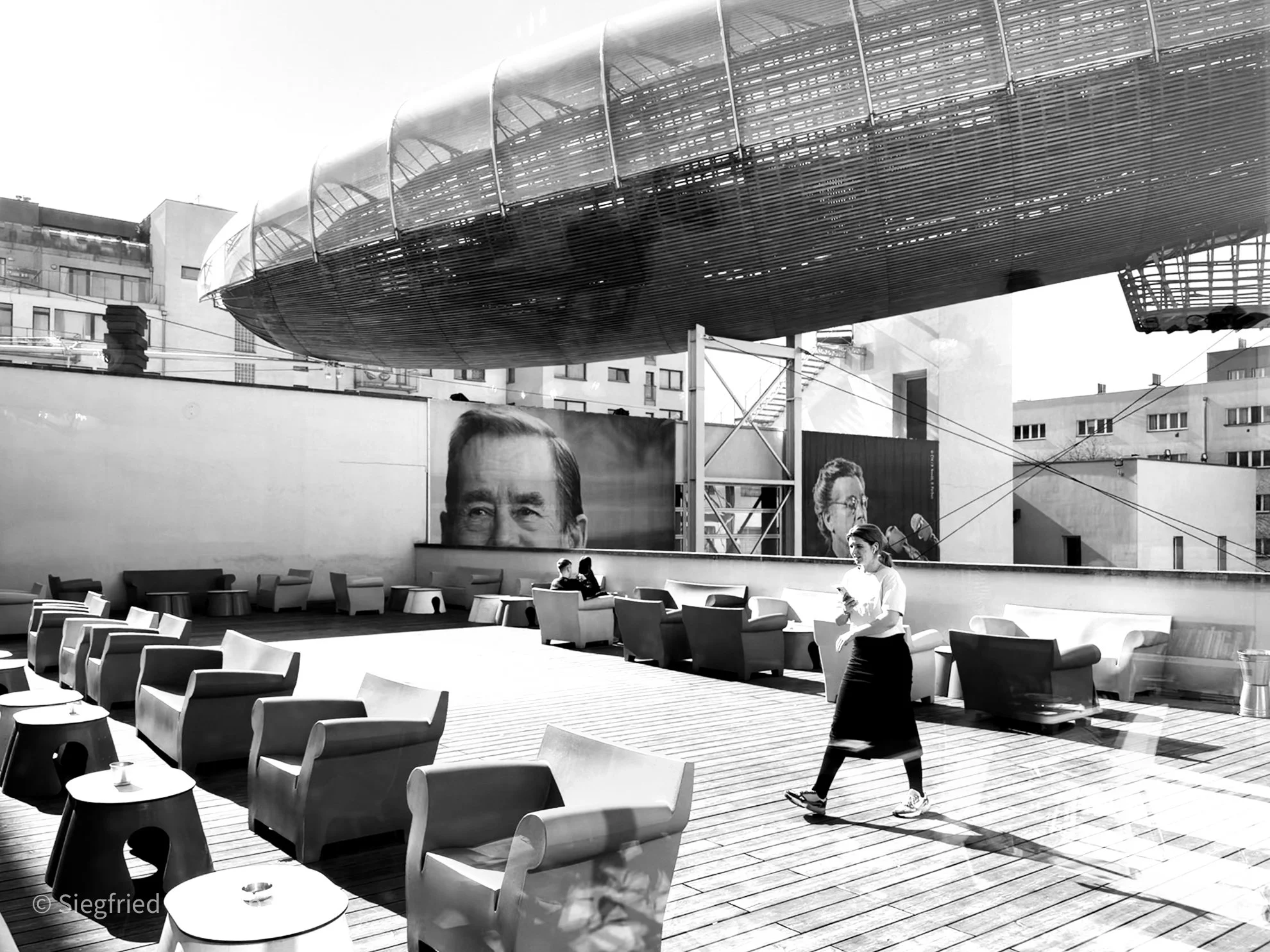
Image 1 — Rooftop with Gulliver: DOX Centre for Contemporary Art, Holešovice. Gulliver — the zeppelin construction of steel and wooden slats above the rooftop terrace.
The Witkin exhibition Broken World spans several rooms. 80 photographs and drawings from his late period, 2010–2025. We had no expectations. Just curiosity.
Who is Joel-Peter Witkin?
Born 1939 in New York, lives in New Mexico. One of the most singular photographers of the 20th century — and one of the most persistently misread. The first time you see a Witkin image, the temptation is to call it provocation for its own sake: corpses, bodily difference, religious iconography, staged tableaux that recall old master paintings.
This is not an artist who lives in darkness. This is someone who looks at darkness directly, because he believes that looking away is cowardice.
The technique as part of the work
Witkin develops his own negatives, prints his own work. Added to this: manual intervention — scratching into the emulsion, acids, toning, collage, encaustic wax applied directly onto the print, sometimes oil painting. Every print is a unique object.
"Every object and person in every photograph is a world to me. I process my own film and I print my own work, which I must because the final print is the final and most clear definition of what I wanted to create."
What this means you can see in the surfaces: these weathered, scratched, spotted prints don't look old because they are old — they were made this way. Time is a deliberate aesthetic choice, not a consequence.
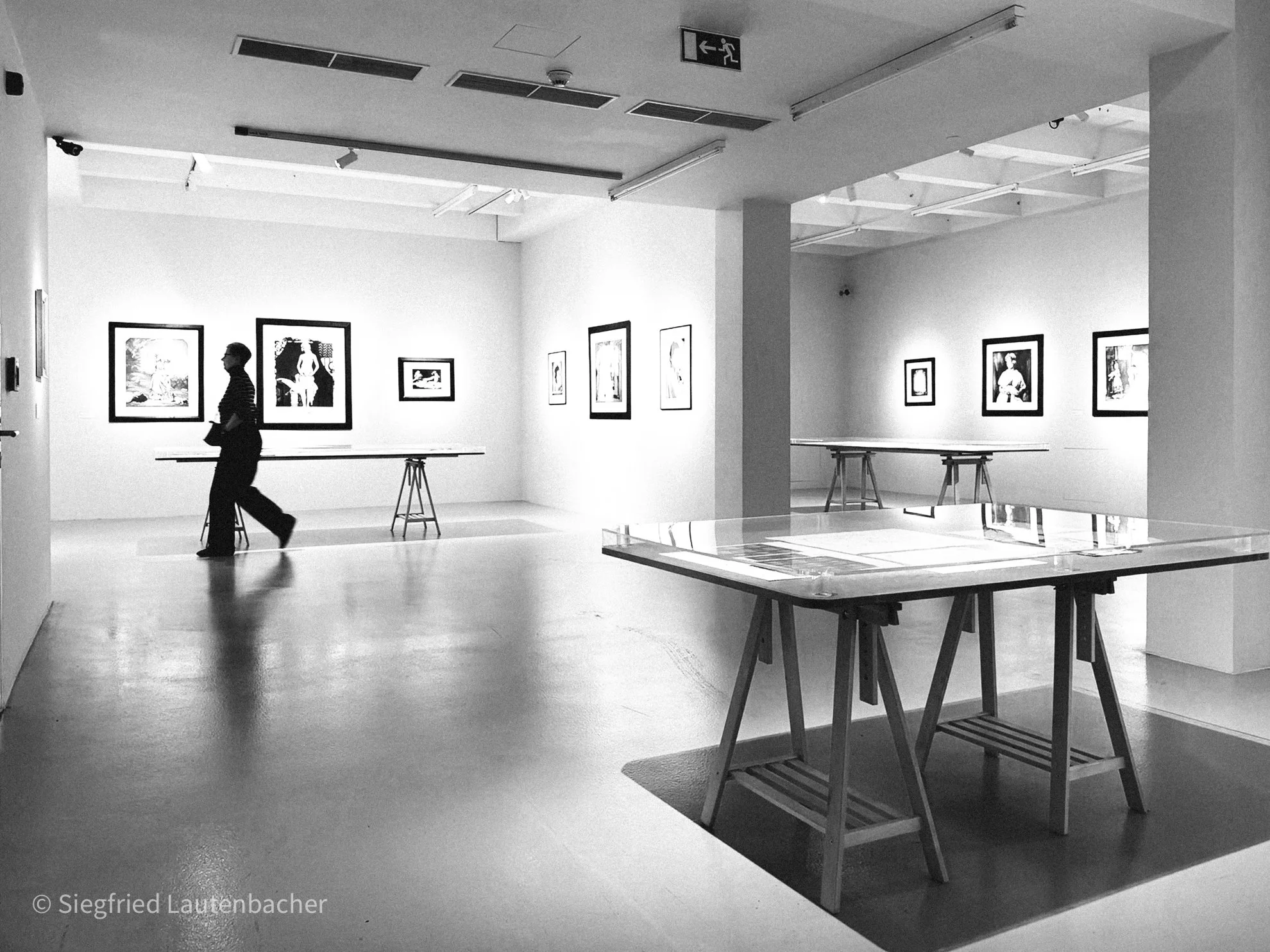
Exhibition room: Broken World, DOX Prague 2026. The sketch vitrines on trestles show Witkin's working process alongside the finished prints.
What we saw
Nietzsche and the Muses (2011, Bogotá) — Two muses, classically nude but wearing shoes and contemporary makeup, stand beside a bearded Nietzsche with a flower crown, writing. To the left, a detail from Van Gogh's Starry Night as the only real colour accent. Paper irregularly cropped, fabric at the bottom. A collage that deliberately collides different time periods — and doesn't apologise for the collision.
The History of the Cross, the Tripod and Photography (2011) — Witkin on photography itself: a baroque history painting on the left as backdrop, a bare studio with tripod and model on the right. Cross, tripod, camera — three instruments of making present. The photographer wears a mask and looks almost clownish. Humour as protection against pathos.
La France et le Monde (2011) — Two heads, Napoleon and a female figure, merge into one body against a painted sky of luminous blue. Napoleon's right eye is missing: a deliberate void. The blind spot of power. The preparatory sketches alongside show the original concept was an Anubis figure shot outdoors. Somewhere in the process it became a political allegory.
Death Is Like Lunch, It's Coming (Paris) — A skeleton offers a flower to a mother holding a newborn — almost politely. The handwritten line runs vertically along the edge: “death is like lunch / it's coming.” Not nihilism. Acceptance.
The Great Masturbator and the Country He Rode In On (2017) — Trump in a corset on the American flag, hammer-and-sickle tattoo on his arm, seated on a phallic stone outcrop. The title quotes Dalí's 1929 painting. Dated March 2017, shortly after the inauguration. Witkin less oblique than usual — but still at a remove through art-historical framing.
Hitler Posing with the Anti-Christ, 1937 (2015) — Encaustic wax applied directly to a silver gelatin print, mounted on aluminum. Hitler in uniform but wearing platform boots and a painted skirt. The Antichrist in toxic blue. The arched format quotes religious altarpieces — the form of Nazi self-deification turned against itself.
Woman Christ (triptych, 2014) — An altarpiece frame, three panels, heavy dark wood. A woman in the role of Christ — the crucifixion, the Ecce Homo, and at the centre a raw, expressionistically overpainted image of chain motifs. A theological question posed without rhetoric: why can suffering not be female?
Above the Arcade (2013, Paris) — One of the quietest works. A woman sits upright, a man lies exhausted behind her. Burnt edges, encaustic layers. Handwritten at the bottom:
"In Paris, above an arcade, are rooms containing endless threads, the weight of time, a monstrous mob of liberated sounds, a shadow of Christ, and a room in which two people have met in our age, an age with little purpose or meaning."
Written in 2013. Could be today.
After several rooms of this, Witkin's own words come back with more weight than they would have at the entrance:
"My photographs are not 'morbid.' Morbid means unhealthy and deformed. I photograph social outcasts because I want to celebrate their singularity and the strength it takes for them to engage with life."
Not a defence. A clarification of what you just saw.
The sketches
What makes this exhibition unusual: many works hang alongside their preparatory drawings. Index cards, yellow lined paper, ballpoint pen. Stage directions, lighting notes, camera formats, budget calculations. For the Trump image: a Polaroid test with the note “too flat, but it screwed as lighting check”, and a photo of an elephant labelled “testicle texture” — a reference for the surface of the stone outcrop.
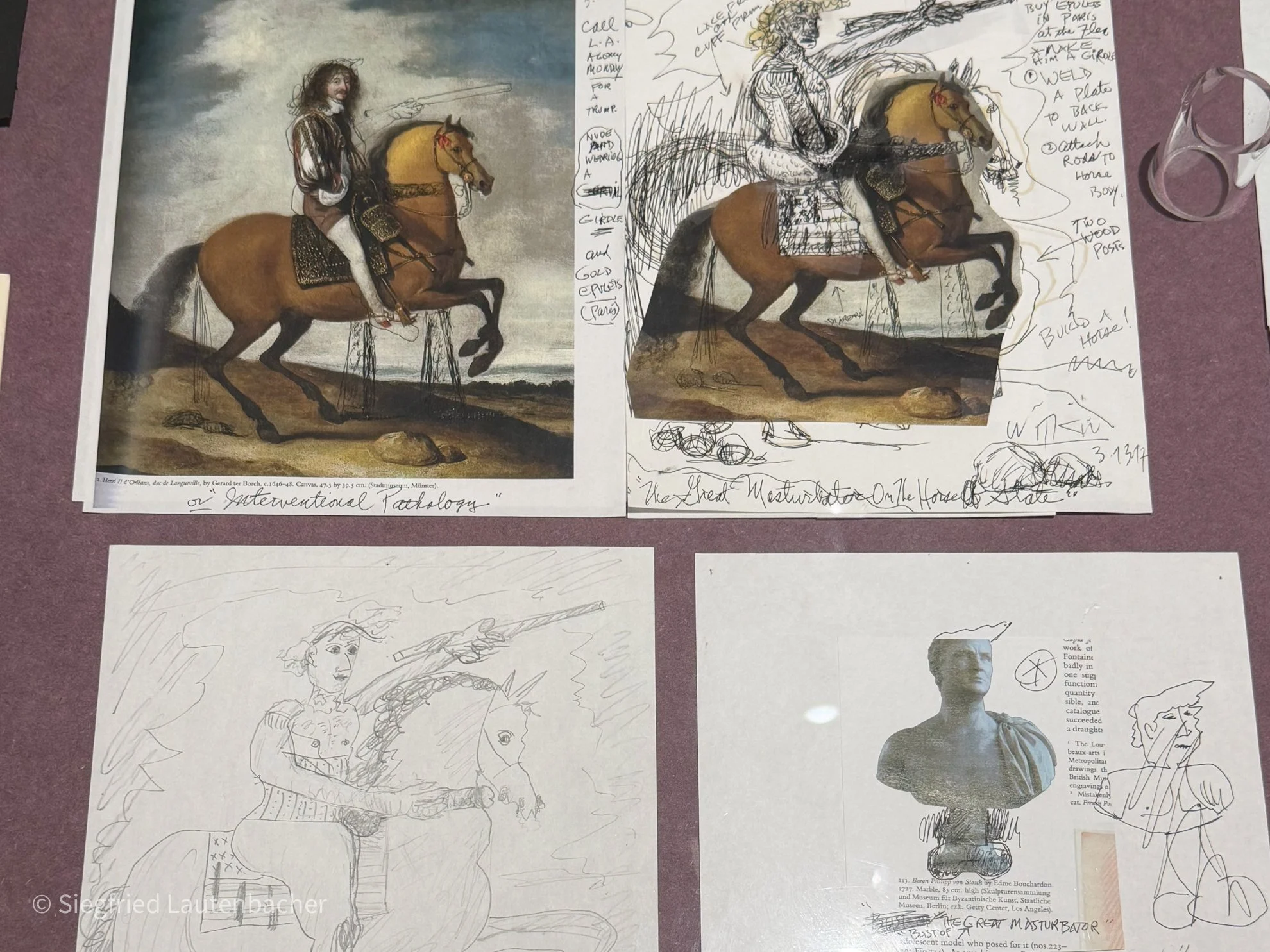
Sketches for the Trump image: Preparatory drawings for "The Great Masturbator and the Country He Rode In On" (2017). On the left the source material — an equestrian portrait of the Duc d'Orléans by Gerard ter Borch — alongside Witkin's interventions, notes, and collage work.
This is not spontaneous photography. It is closer to film direction. Every image is prepared over months, sometimes years. Seeing the working process alongside the finished prints shifts something: what looks like excess turns out to be precision.
What remains
The exhibition text describes Witkin's work as a “discipline of seeing.” That phrase stuck. Those who accept his rhythm — slow down, don't flinch — don't leave with a ready verdict. They leave with an altered capacity to sustain a gaze.
His final statement in the exhibition:
"I don't believe that photography should be only in the moment. Obviously, it's made in the current moment, but it can be about the past and about the future, just like filmmaking, because it's the story of life and how life changes."
That's not a statement about tempo. It's a statement about what an image can hold. That is a position I share — the moment is never only itself. Street photography and months-long studio preparation are different tempos, but the same underlying claim: that an image can carry more time than the instant it took to make.
Seeing as practice
What Witkin calls a “discipline of seeing” is more than an aesthetic stance. It's an invitation to sustain a gaze — to not look away when something becomes uncomfortable, not to categorise before you've really looked.
That sounds simple. It isn't.
Most of the time we look in order to finish quickly. The image gets identified, evaluated, filed. The algorithm of everyday life: recognise, react, move on. What this exhibition disrupts — in the best sense — is that Witkin's images refuse that process. They don't allow themselves to be dealt with swiftly. The scratched surfaces, the encaustic layers, the handwritten lines along the margins: all of it comes toward you, it doesn't wait to be retrieved.
That's a different kind of experience from most. Not: I form the image. Rather: the image meets me.
Witkin's images demand exactly that. They show people whose lives were not given an easy shape, and they ask: Can you look without judging? Without the pity that keeps its distance? Without the quick glance that's already turning away?
His answer is the gesture of celebration: “I celebrate the courage to live.” That's not consolation, not softening. It's recognition. That's what a gaze can do when it takes the time.
Witkin works for months on a single image. On the street I work in fractions of a second. Perhaps you need both schools — one teaches speed and openness, the other teaches how to hold still.
DOX Centre for Contemporary Art Poupětova 1, Praha 7 – Holešovice Tue–Sun 11:00–19:00 · dox.cz