What We Choose Not to Lose
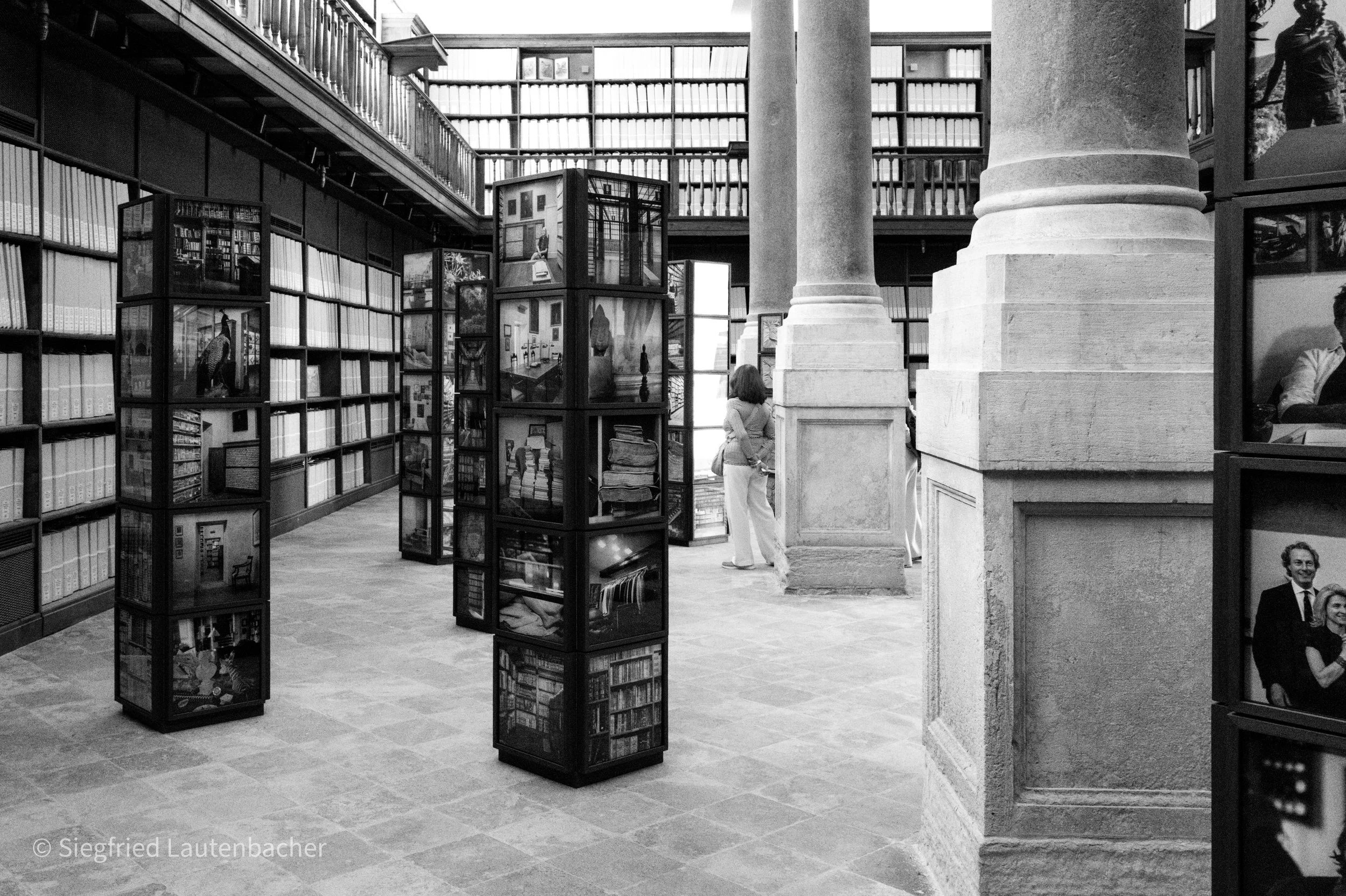
Pillars among the archive shelves. ARCHIVIO, Archivio di Stato di Venezia, May 2026.
A first note on Dayanita Singh's Archivio at the Archivio di Stato, Venice (Part 1 of 3)
The Archivio di Stato in Venice has never before opened its doors as an exhibition venue. The reason it does so now, for the first time in its centuries-long history, is named Dayanita Singh.
ARCHIVIO, curated by Andrea Anastasio, runs from 17 April to 31 July 2026. It will travel afterwards to Villa Giulia in Rome, the MAO in Turin, and the Istituto Italiano di Cultura in New Delhi. But Venice is the beginning, and Venice is where the work belongs first. Singh has photographed Italian cities for twenty-five years — Venice, Rome, Florence, Milan, Naples, Turin, Como, Bologna, Palermo — and the doors that opened to her over those years were rarely opened by institutions. They were opened by friends.
The press text for the exhibition uses an unusual phrase for this: a patronage of care and reciprocity. It is a quiet reframing of an old Italian word. The patrons in Singh's case are not the foundations or the corporations. They are the people who let her into their houses, their libraries, their family collections, their storerooms, their silences. In return, she has photographed them, and their spaces, with a kind of attention that the press text rightly calls a relational cartography rather than a survey. She inhabits these places lightly. She listens more than she declares.
What you see when you enter the Archivio di Stato is the material form of this practice. Fifteen wooden structures — Singh calls them pillars — stand scattered across the archive hall, each one capable of holding twenty square photographs in a stacked, four-sided arrangement. Around them, on shelves running along the walls, are the actual archives of the Venetian state: cream-coloured cardboard boxes, numbered, labelled, tied with cotton ribbon. Catasto terreni. Atti preparatori. Ufficio tecnico erariale Venezia. The institutional memory of a city.
Singh's pillars stand in that company as guests, not commentators. The wood is the same warm tone as the shelves. The scale is sympathetic. The photographs inside are mostly black and white, square, mounted behind glass. They show what she has been allowed to see over twenty-five years: a staircase in a private palazzo, a marble figure reclining in afternoon light, an archivist holding a bound volume, a cabinet of antique heads, a flowering tree, bronze vessels, a hand of a Roman statue, an inscription on stone. There is no hierarchy among the subjects. An archivist and a bunch of flowers occupy the same square, with the same care.
This is the first thing the exhibition asks you to notice: that an archive is not a place where things are stored. An archive is a practice of choosing what to keep.
Walk further, and you find smaller works tucked into the existing shelves. Between boxes 73 and 75 of the Censo stabile, a five-panel accordion stands open. The photographs show red cloth bundles — Indian archival documents, hand-wrapped in dyed fabric that fades over years of light exposure, leaving ghost edges where the cloth has tightened around the manuscript inside. Singh photographs these wrappings the way one photographs faces. They have aged. They have been handled. They have been chosen.
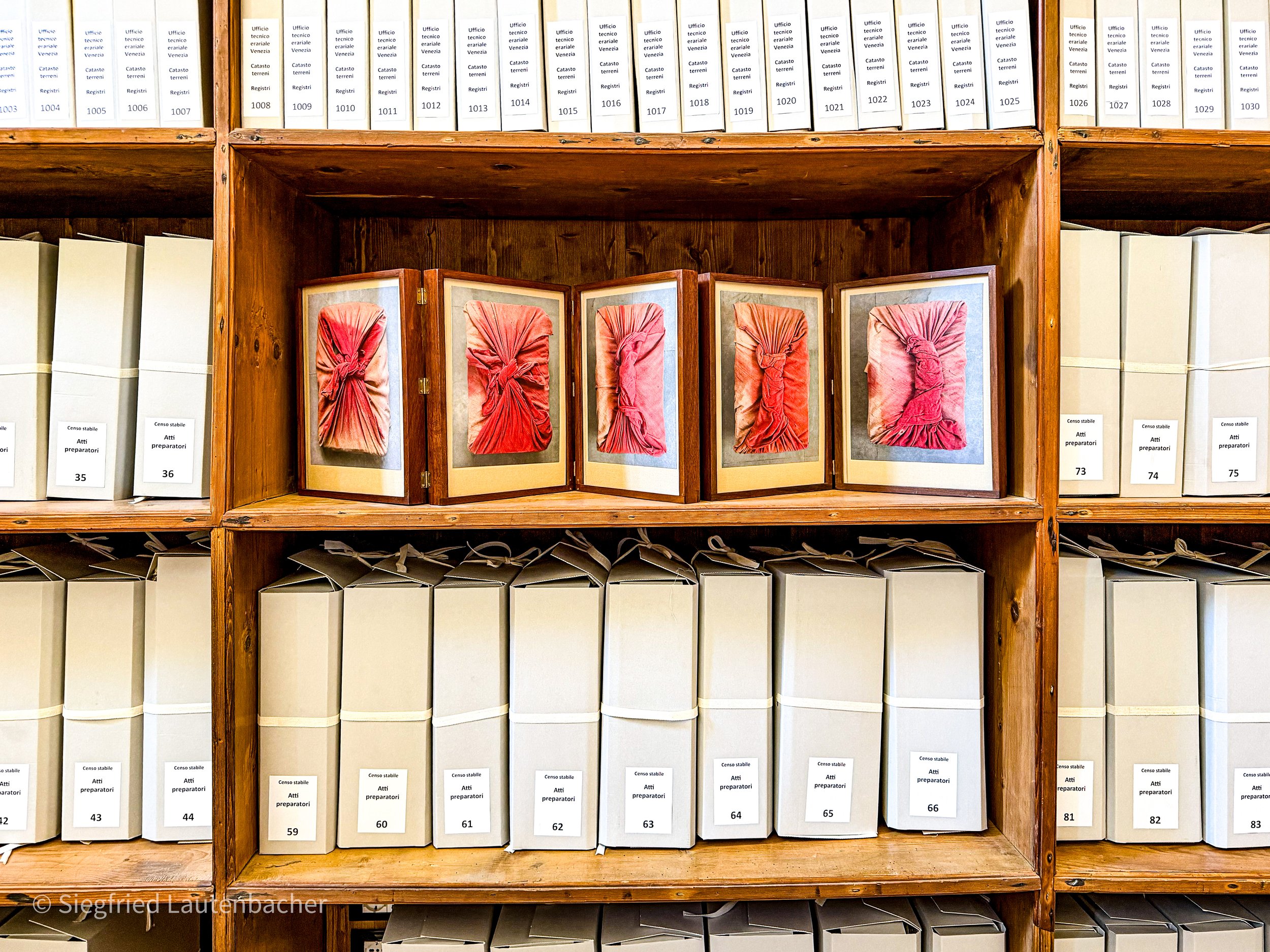
An accordion of red cloth bundles, set between the Censo stabile boxes.
The placement is the argument. Italian archive boxes and Indian cloth bundles are two answers to the same question: how do we protect what we have decided is worth protecting? The press release notes, almost in passing, that twenty of the 350 photographs in the show are portraits of patrons and friends — the people who made the work possible. Singh does not hide her access. She thanks it, openly, by name.
This is a different kind of archive than the one we are becoming familiar with.
Most of what we now call "memory" no longer behaves this way. The systems that increasingly shape our cultural recollection do not choose. They absorb. They process every available text, image, voice, document, and they do so without ceremony, without ribbon, without red cloth. Whatever is reachable is taken. Whatever is taken is dissolved into statistical weight. Nothing is held as itself. Nothing has a wrapping.
I do not want to make ARCHIVIO into a polemic against this. Singh and Anastasio are not building a polemic. They are building something quieter and more difficult: a working example of what care looks like when it is applied to memory over decades, in friendship, in repetition, in slow return.
But standing between Singh's pillars and the state's shelves, in a room where every cream-coloured box has been chosen, tied, and numbered by someone, the contrast does its own work. The word archive itself remembers this: it comes from the Greek archeion, the house of the rulers, the place where what counts is kept. An archive was never a hard drive. It was a claim about meaning. Someone has to decide what is worth keeping. Someone has to do the wrapping. Someone has to know, by heart, where each register stands, and remember why.
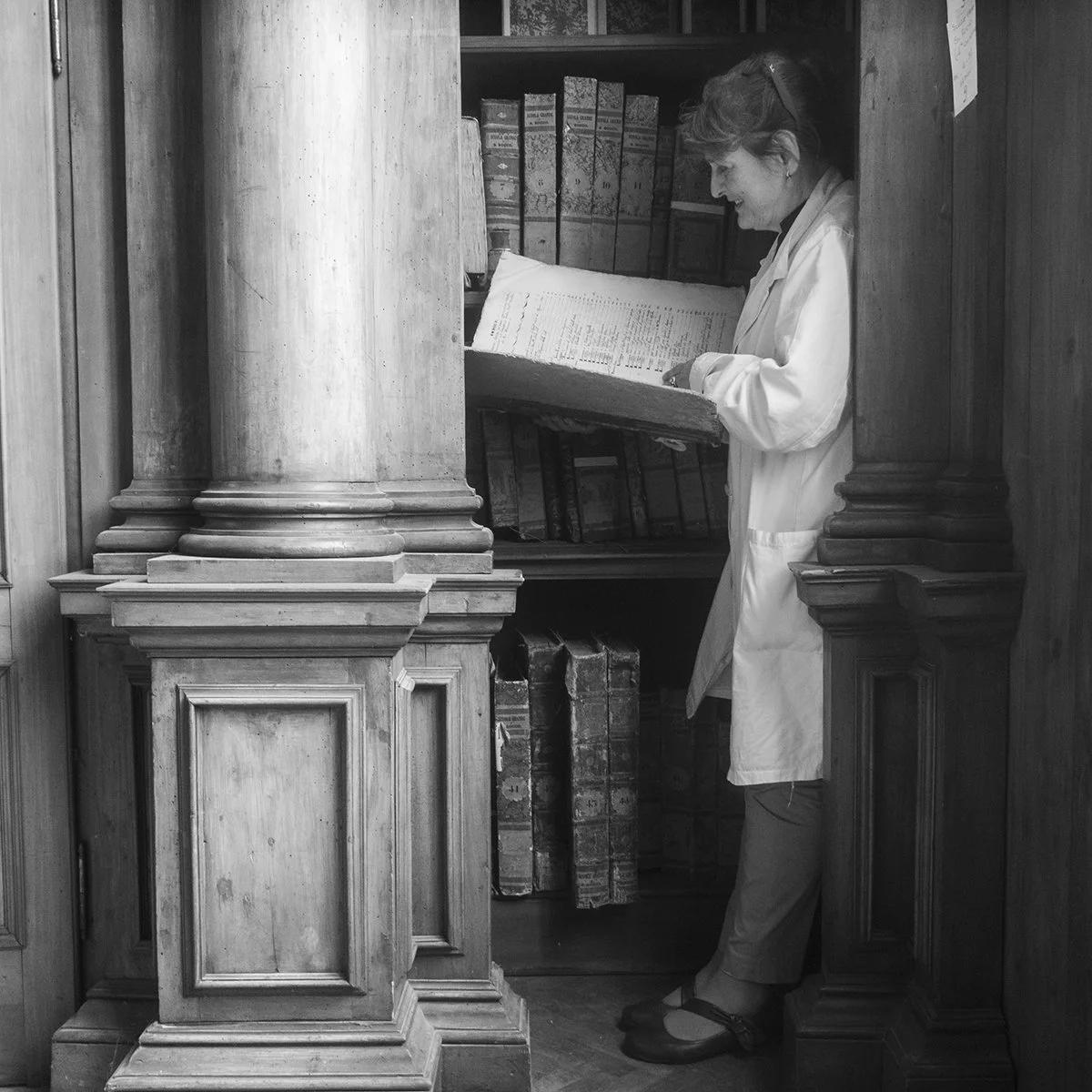
Dayanita Singh, From Venice Pillar 2. Press image. © Dayanita Singh / Archivio.
The exhibition title is plain. Archivio. Just the word. As if Singh and Anastasio were saying: this is what the word actually means. Look.
I will return to the exhibition in two further notes. The next will go deeper into what it means, in 2026, to insist on singular images against systems that turn images into probability. The third will be about a pillow on a sofa in one of the photographs, with the words Go Away Closer embroidered on it.
For now, just this: ARCHIVIO is the first time the Archivio di Stato di Venezia has opened its doors as a public exhibition. It will not be the last good reason to come, but it may be the most quietly radical one for a long while.
ARCHIVIO. Dayanita Singh, curated by Andrea Anastasio. Archivio di Stato di Venezia, Campo dei Frari.17 April – 31 July 2026, Monday to Friday, 12:00 – 18:00. Free admission.